Scott Holder reviews the Alesis Turbo MAX
We’ve classified any e-kit costing $500-$1,000 as “introductory” and anything under $500 as “budget”. I’ve reviewed many of these: Simmons SD600 (dD Aug 2020), KAT KT-200 (dD Nov 2020), Roland TD-07 (dD Nov 2021), KAT KT-300 (dD Feb 2022), ddrum E-Flex (dD Aug 2022), Donner DED-200 Pro (dD Feb 2023), Simmons Titan 50 (dD Nov 2023) and the Alesis Nitro PRO/MAX (dD Feb 2025). The lowest price for any of those kits was either the early DED-200 or the E-Flex, both at $350. The new Alesis Turbo MAX drops the price floor for a mesh-based kit even lower – below $250. To put that in perspective, the entire kit costs about the same as one or two components from brands like Roland or Yamaha.
At this price point, what are the compromises?
What’s in the Box
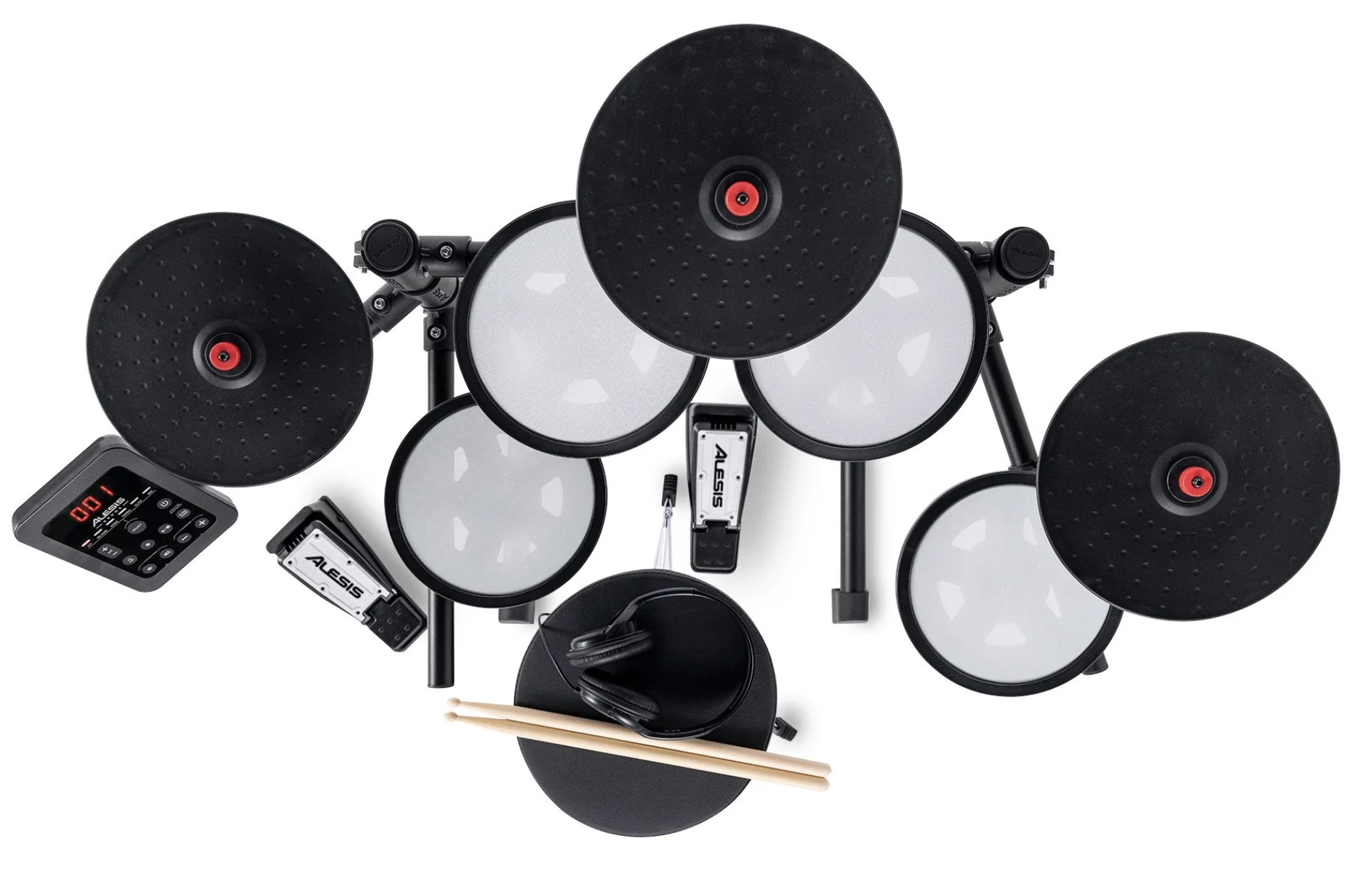
The Turbo MAX includes everything a beginner needs: sticks, a throne, headphones, the module, four 8” mesh pads, three 8” rubber cymbals, and two foot controllers for the kick and hi-hat (a design similar to the ddrum E-Flex).
The rack features standard-sized tubing for the vertical and foot bars, but the connecting bars are smaller. The overall footprint is quite small. Crucially, the cymbal mounts can be placed anywhere on the smaller horizontal bars, not just the two vertical poles, which allows for better placement. Everything connects via a standard wiring harness, and the crash/ride cables were long enough for left-handed setups.
The Module
Connectivity is basic: the main harness, a standard USB-to-Host port, a 3.5 mm stereo input for external audio, and 3.5 mm (headphones) and 6.35 mm (amp) stereo outputs.
It comes with 12 preset kits and a sound library of over 120 instruments. The 20 onboard songs are an odd mix, blending typical rock and funk with old standards like Danny Boy and Jingle Bells that most younger users won’t recognise.
To scroll through kits, you use the buttons, but kit names are not displayed on the unit. Critically, there is no way to assign different sounds to individual pads, nor can you customise or save kits. You are locked into the 12 preset kits. The only kit parameter you can edit is Reverb, which is applied universally to the whole kit.
Bluetooth streaming from an external device is easy to connect. The module can also function as a MIDI controller, but any changes to MIDI numbers must be managed on the computer side.
Metronome/Click settings are on/off, tempo, time signature, volume and the click sound.
The Song area allows changing the volume of the drum part and the tempo.
Recording is simple: press the button and when a pad is hit, the recording starts. Press Play/Stop and you are done. You cannot play along to an onboard song and record. You cannot save what you record.
Bluetooth connectivity is from a streaming device like a smart phone to the module and was easy.
Training is done online via Melodics.
The Pads
The single-ply mesh pads offer good, uniform bounce, comparable even to higher-end foam snares we’ve tested. Noise from errant stick hits is minimal. The snare and toms are single zone.
The cymbals are also single zone and cannot be choked. They require loose mounting for any natural flop. They are slightly louder than cymbals from other brands, but not excessively so.
The foot controllers are robust and consistent in response. The hi-hat provides typical articulation: open, half-open, closed, and chick. The kick pedal, however, is a standout, feeling springy and responsive for faster patterns, making it the best of its kind we have tested on a kit this size.
The Sounds
While Alesis doesn’t tout the underlying sound engine, the traditional acoustic kits are generally good, comparable to the E-Flex and earlier Simmons kits. The toms have a deep resonance, and the kick sounds are excellent.
The hi-hat is a high point, with bright, dynamic sounds and more range than the Nitro PRO/MAX kits, and is on par with the Titan 50 and even the Yamaha DTX4 series. The snare is also surprisingly dynamic for its size and price, allowing for decent ghost noting and rolls, though machine gunning is still a given.
The weakest link is the crashes. They lack crispness and decay, and remind us of very early Simmons sounds (not a compliment). The ride is adequate but a step behind the TD-07.
In Action
This kit is designed to be set up and played with virtually no adjustment required.
The hi-hat rig was the kit’s best component, offering reliable, sloshy, dynamic sounds. The kick controller is easily the best we have reviewed in this class, feeling reactive and requiring minimal effort.
As a MIDI controller for a VST like EZdrummer 3, the Turbo MAX is outstanding. It was plug-and-play, though it initially suffered from noticeable latency. This was easily fixed on a Windows computer by configuring ASIO4ALL and maxing out the latency compensation settings within the VST software. When triggering VSTs, the crash sounds were vastly improved and even allowed for a semblance of 2-zone cymbal swells.
Overall, the kit is very quiet with no ‘loud points.’ The rack is sturdy, and the pads mount tightly, a big improvement over the MAX rack. Overall playability feels more “realistic” than other tiny introductory kits like the E-Flex or DTX4 series because of the improved hi-hat and surprisingly dynamic snare.
Limitations
The Turbo MAX has three main limitations:
- Poor crash sounds: The crash sound and triggering are almost toy-like on the module itself.
- Small Sound Library: The 12 kits/120 sounds are the smallest of any kit we have reviewed, which may limit the kit’s longevity as a player’s skills grow.
- Lack of customisation: The most significant flaw is the inability to reassign sounds to pads. This is a basic feature on comparable kits like the E-Flex and DTX4 series and is a major restriction, even for beginners.
Conclusion
If you are looking for the most economical way to introduce a beginner to the basics of drumming without a huge financial commitment, the Turbo MAX is an excellent option.
If you are an experienced player looking for a super-compact, mesh-based MIDI controller that performs better than expected (provided you know how to configure it for low-latency VST play), the Turbo MAX delivers exceptional value for its price.
SPECIFICATIONS
Drum sound module: Turbo MAX
Max polyphony: 32
Drum pads: 4 x 8” mesh (interchangeable for snare/toms)
Cymbals: 3 x 10” single-zone (non-choke)
Kick: controller pedal
Hi-hat: controller pedal; 8” single-zone pad
No. of kits: 12 Preset
Songs/Samples: 20
No. of instruments (voices/sounds): 110
Kit parameters: Reverb
Click tempo range: 30-250 bpm
Pad connection: Wiring harness to ¼” stereo; 2 x ¼” to ¼” stereo
Interface: USB to Device; Bluetooth
Outputs: 1 x 1/8” stereo (headphones); L/R ¼” stereo (TSR balanced)
Inputs: 1/8 ” stereo
Latency: 6.8 ms (as measured with EDLM by ONYX apps)
Street Price: $249