
If you own a Roland TD-12 or TD-20 module, you already know you’re caring for a vintage classic. Roland stopped supporting both modules almost two decades ago, and genuine replacement screens have long since disappeared from the official supply chain. That’s why the sudden appearance of a plethora of new TD-12/TD-20 replacement screens on AliExpress — most around the US$100 mark — will no doubt raise a few hopeful eyebrows.
Unfortunately, hope isn’t the same as certainty.
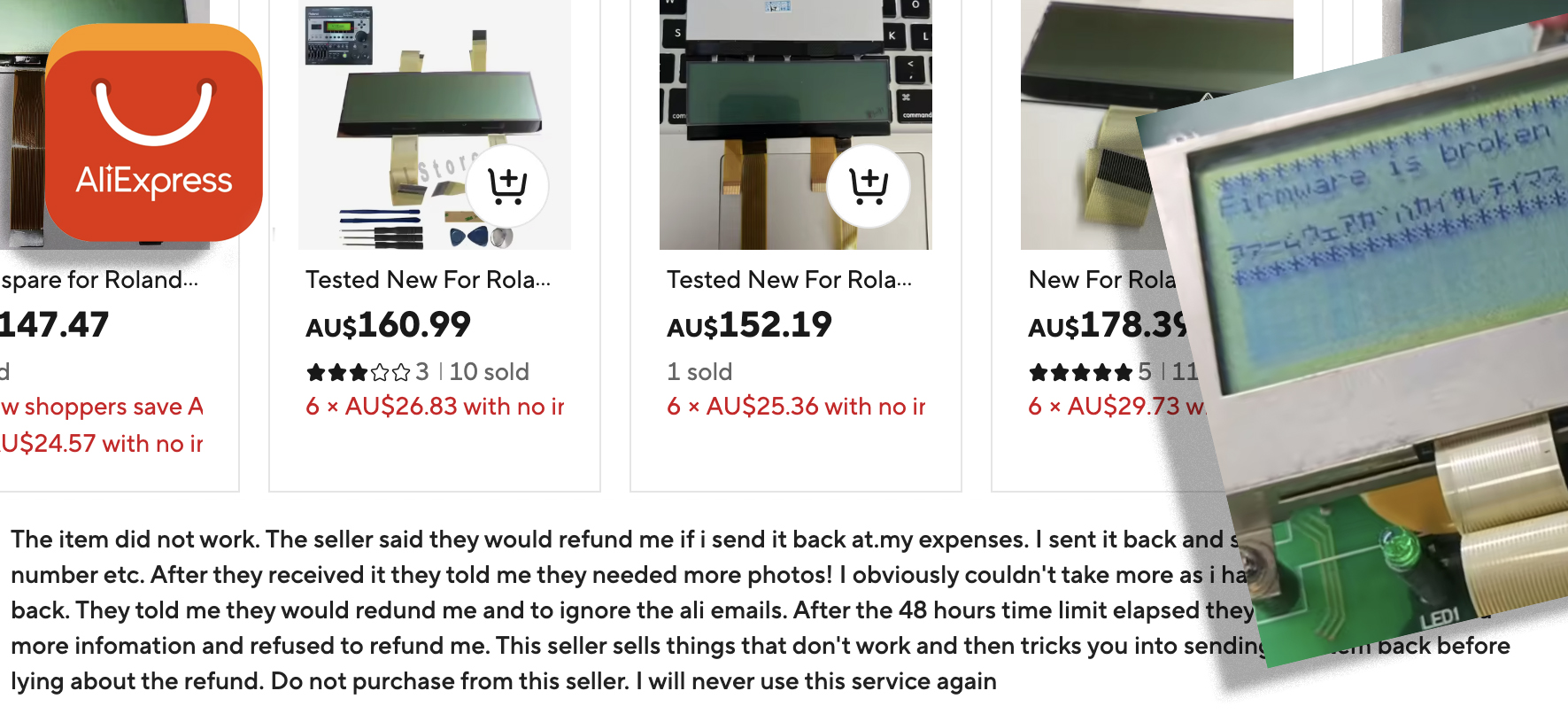
A quick scan of buyer feedback paints a very mixed picture. One frustrated customer reports that his screen didn’t work at all. After the buyer was asked to return it at his own cost — and complying — the seller then demanded additional photos after receiving the returned unit. When the buyer understandably couldn’t provide them, the promised refund evaporated as the AliExpress dispute window quietly closed.
Another buyer on Reddit warns: “Bear in mind that what is being sold on Aliexpress is not a complete screen, but just a naked glass COG panel. It is not only missing the backlight but also the PCB board. …. It comes with two flimsy ribbon cables (same design as original), which cannot be plugged directly to the module as it requires a 10-pin connector cable, so you will have to use the PCB board from your old screen.”
On the other hand, some buyers leave five-star ratings.
Most of the vendors record very small numbers of sales and no reviews. But beyond the testimonials, there are some telling — and troubling — clues. In one listing, the vendor’s own product photos, with the unit powered on, shows a firmware “broken” message on the screen. That’s hardly a confidence booster.
It also appears these AliExpress displays are direct LCD replacements rather than the carefully engineered full PCB-based replacement boards previously reviewed in digitalDrummer. Those full boards were designed to replicate the original display behaviour and have been tested by real module owners worldwide. They’re sold by known suppliers, backed by real warranties—though some warranties only apply with professional installation.
digitalDrummer was among the outlets supplying these emulator screens, but we have chosen not to restock. Demand has tapered off, and frankly, the administrative hassle of supporting increasingly fragile hardware has outweighed the satisfaction of helping extend the life of ageing modules.
And “ageing” really is the operative word. As these brains pass the 15- to 20-year mark, we’re seeing more reports of rupturing capacitors, brittle ribbon cables and other components nearing end of life. One tech summed it up bluntly: “These modules are ticking time bombs. Many will eventually need full capacitor replacements — not just new screens.”
So, what’s the smart play?
Proceed with caution. A sub-$100 AliExpress screen might seem like a bargain, but the risks of DOA units, shaky refund processes, dubious firmware and untested longevity are real.
And before spending $200 or more on an after-market emulator screen, take a moment to consider whether the investment makes sense. The TD-12 and TD-20 were great tech in their day, but they’re undeniably showing their age in sound quality, triggering sophistication and modern features. Add the increasing likelihood of electronic failure, and the economics become harder to justify.
In short: cheap solutions can become expensive lessons. If your screen is fading or has already failed, weigh your options carefully. A newer module — or even a different ecosystem — may offer far better long-term value than resuscitating a two-decades-old brain whose best years are behind it.