
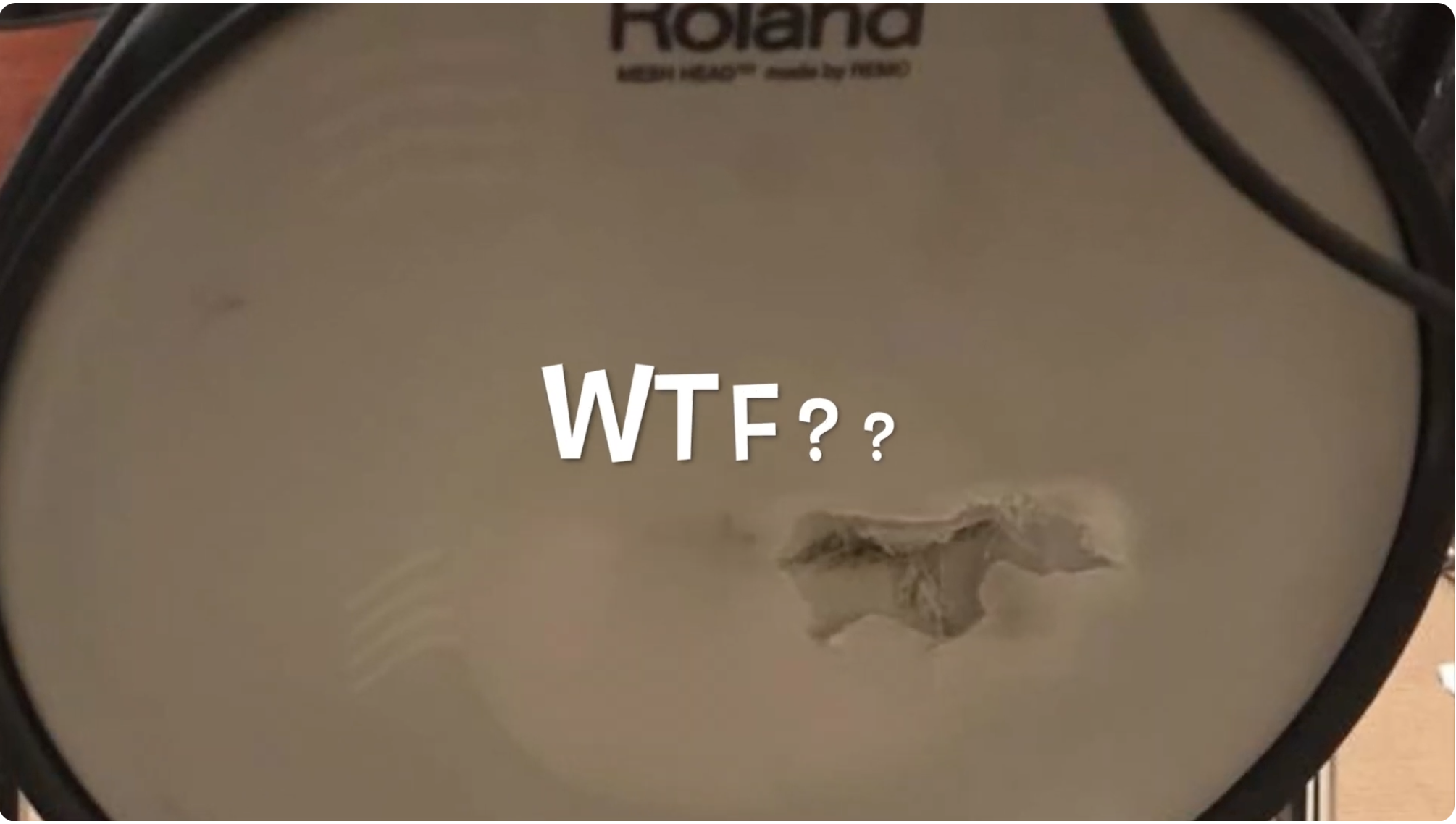
We see it regularly: pictures of a mesh head kick drum that look like someone has attacked them with a hot branding iron. And generally captured in the same shot is the culprit — a felt beater.
For e-drum old-timers, that’s a red flag. Experience has taught us to use only hard beaters — plastic or wood. But what exactly is the reason for the antipathy between two seemingly soft substances?
According to Roland Australia V-Drums specialist Simon Ayton, the main cause is felt wearing down, “leaving the sharp edge exposed where the felt part is inserted into the plastic beater”. However, photo evidence suggests this is only part of the story. Most shared images show a broader damage zone — often the full size of the beater face — which points to something more systemic going on.
Stress concentration and fatigue
Felt is firm but has very low elasticity compared to mesh. When a felt beater strikes a mesh head, the force is concentrated into a relatively small contact area. Unlike a plastic or wood beater — which distributes force across a defined rigid surface — felt compresses slightly on impact and then rebounds, with its fibres creating multiple tiny stress concentrations across the individual strands of the mesh weave. Over thousands of repeated impacts, this causes fatigue failure in the polyester or nylon fibres at those stress points, eventually causing them to fray or snap.
Why felt is paradoxically more damaging than hard beaters
This is counterintuitive but well established. A hard beater delivers a sharp, brief impulse — the contact time is very short and the force, while higher at peak, dissipates quickly. Felt prolongs contact time because it deforms around the mesh surface. This means the mesh fibres are held under tension and compression for longer per strike, which accelerates fatigue. It’s a similar principle to why a slow, grinding force can damage materials that easily resist a sharp blow.
The abrasion factor
Felt fibres are also mildly abrasive at a microscopic level. The weave of the mesh head creates crossing points where strands rub against each other under compression from the beater. Felt’s fibrous surface — rather than a smooth one — engages with that texture and creates micro-abrasion at those crossing points with every hit, gradually wearing through the outer protective coating on the mesh strands.
Heat
Repeated high-velocity impacts generate localised heat through friction, particularly at the contact point and at the mesh’s weave intersections. Polyester and nylon both have relatively low melting points and can weaken significantly well below those temperatures — repeated thermal cycling at the strike zone gradually degrades the polymer chains in the fibres.
The practical upshot
The combination of prolonged contact time, abrasion, and heat explains why manufacturers consistently recommend hard or semi-hard beaters for mesh heads. Felt works perfectly well on acoustic heads — which are far thicker and made of Mylar — but the much finer mesh used in electronic pads simply cannot absorb the cumulative damage in the same way.
Roland has gone a step further than most, shipping its KDP-5 adhesive patch with all mesh head kits. Designed specifically for V-Drums kick pads, it uses a multi-layer fabric, resin and adhesive structure that Roland says “greatly reduces pad wear without affecting playing feel.” The KDP-5 also features a unique notched profile that the company says ensures a lasting bond through intense playing sessions — an important characteristic, given that e-drummers have long used regular kick patches (primarily designed for Mylar) only to find they peel off relatively quickly.
It’s a sensible precaution. But the most reliable protection remains the simplest: keep felt beaters well away from mesh heads.
See our video here.