
By Raul Rodrigues, founder of Upbeat Studio
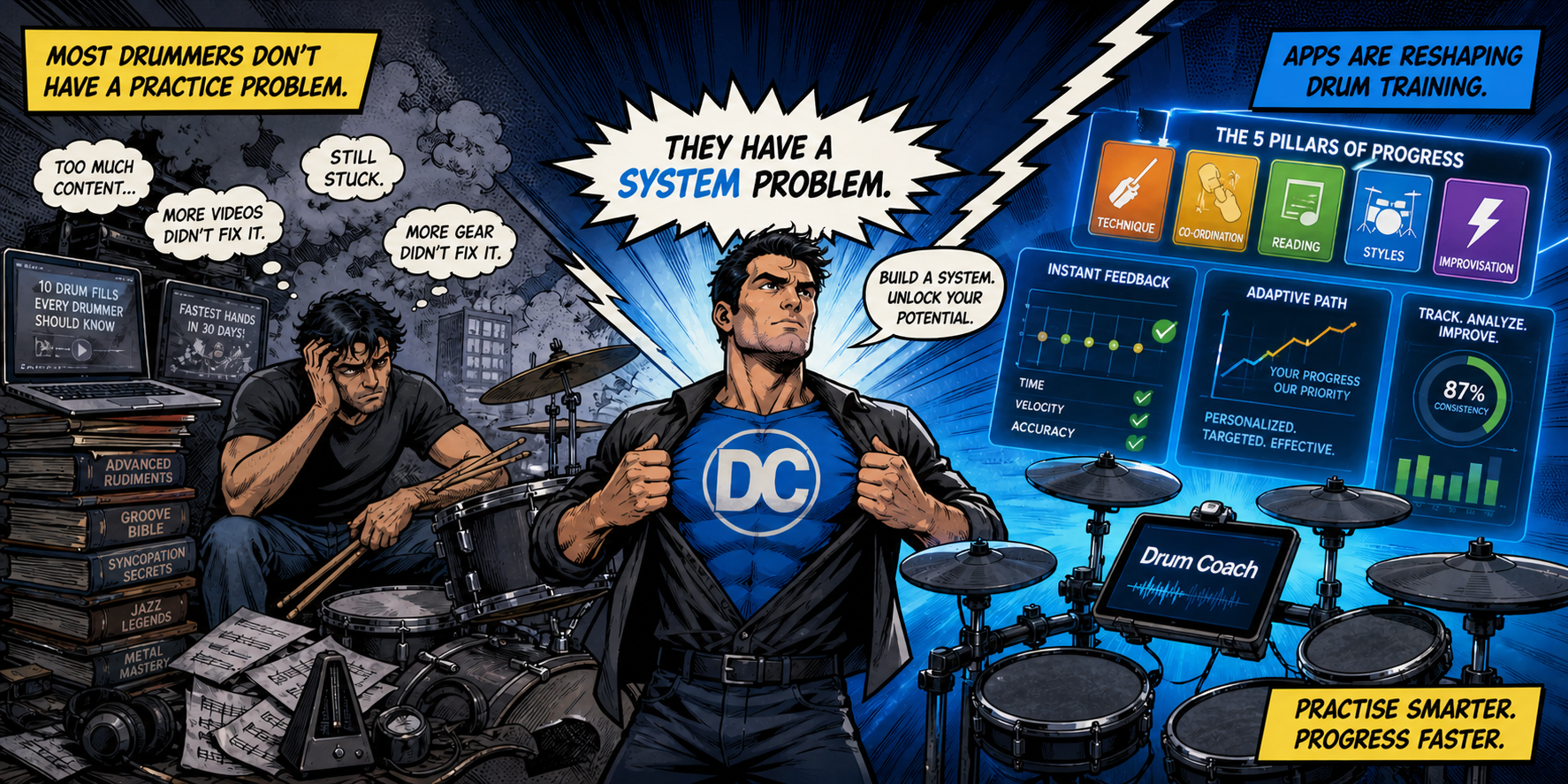
Two years ago, I started building the Drum Coach app because of something that had been bothering me. I’d watch drummers sitting in front of more material than any generation in history, and still feeling stuck. More videos didn’t fix it. More gear didn’t fix it.
I had a hunch the problem wasn’t content. It was the absence of a system.
Twenty thousand drummers later, I’m more convinced of that than when I started.
The bottleneck moved.
The hard part of learning drums used to be access: finding a teacher, finding the right book, finding someone who could show you a Tony Williams transcription. That problem is gone. Today, you can drown in content before breakfast.
And yet the data on music education is grim. In Spain, where I’m based, around 80% of students who start in formal music conservatories drop out before completing the cycle. That’s not a story about a country, it’s a story about a model. The same one exists everywhere: a curriculum designed in the 19th century, applied to a student who lives in the 21st.
The contrast is what’s interesting. Private music academies in the same country target retention rates of 90%. Same students. Same instruments. Different system. The free-market schools survive by adapting to the student. The traditional ones expect the student to adapt to them.
That lesson scales beyond music schools.
What I’ve learned from 20,000 drummers using the Drum Coach app.
I’ve been watching how real drummers actually use our app: what they pick, what they skip, what they grind on and this has revealed a few patterns.
There’s a difference between playing and practising, and most drummers don’t know it. Playing is repeating what you already know. It feels good. It’s also why people plateau. Practising means working at the edge of what you can execute cleanly. Unfortunately, this is uncomfortable, slower than you want and sometimes ugly. Most home practice we see is just playing in disguise. A great practice session might sound terrible. But, that’s where growth lives.
Coverage matters more than effort. Every skill in drumming falls into one of five buckets: technique, co-ordination, reading, styles, and improvisation. We call them the five pillars. The drummers who progress aren’t the ones who hammer on one, they’re the ones whose practice rotates through the right ones for where they are. A beginner needs heavy technique and reading. An intermediate shifts toward co-ordination and styles. The advanced player invests in improvisation. Genre matters, too. A jazz drummer’s pillar mix looks nothing like a metal player’s. Most drummers practising alone never adjust this. They practise the same way at year five as at year one.
Improvisation is a diagnostic, not a reward. When you free-play, your weaknesses surface. You rush a fill, lose time on a transition, can’t execute a pattern you heard in your head. Those moments aren’t failures, they’re tomorrow’s targets. Drummers who treat improv as a tool get better. Drummers who treat it as the fun part at the end stay where they are.
None of this is news to a serious teacher. What’s striking is how rarely a drummer practising alone at home does any of it on purpose.
Why electronic drums change the equation.
Acoustic drums make sounds. Electronic drums produce sounds and data. Every hit, every velocity, every millisecond of timing is measurable and analysable. That’s a different relationship with the instrument, and the practice tools in our pocket haven’t caught up.
Some apps already give instant feedback while you play, whether your hits are landing in the pocket, whether your accents are clean, whether your tempo is drifting. That’s useful, but it’s just the first layer.
The bigger opportunity is using that data to adjust the learning path itself. Not “you missed that note”, but “you’ve been struggling with this rudiment for three weeks, so let’s slow it down and add a coordination exercise that targets the underlying issue”.That’s the layer we’re working on at the Drum Coach app.
A great teacher does this naturally. They watch you, diagnose and adjust. The problem is that great teachers don’t scale, there aren’t enough of them, they’re expensive, and most of the world has never had access to one. Software can carry some of that work now in a way it couldn’t five years ago. If it works, a kid in Mumbai or a returning drummer in rural Australia gets something they couldn’t have had before.
The boring truth.
The drummers who get good aren’t unusually talented. They aren’t unusually disciplined either. They’ve had something: a teacher, a book, a routine, a system that told them what to do this week. That’s it.
If you’ve been stuck for a while, the answer probably isn’t another video. It’s a structure.
Find one. Build one. Use a tool that gives you one. It doesn’t really matter which. Just stop opening eight tabs and playing for four minutes.
Raul Rodrigues is a professional drummer based in Valencia, Spain, and the founder of Upbeat Studio, makers of the Drum Coach app and the Drum Notes app.