
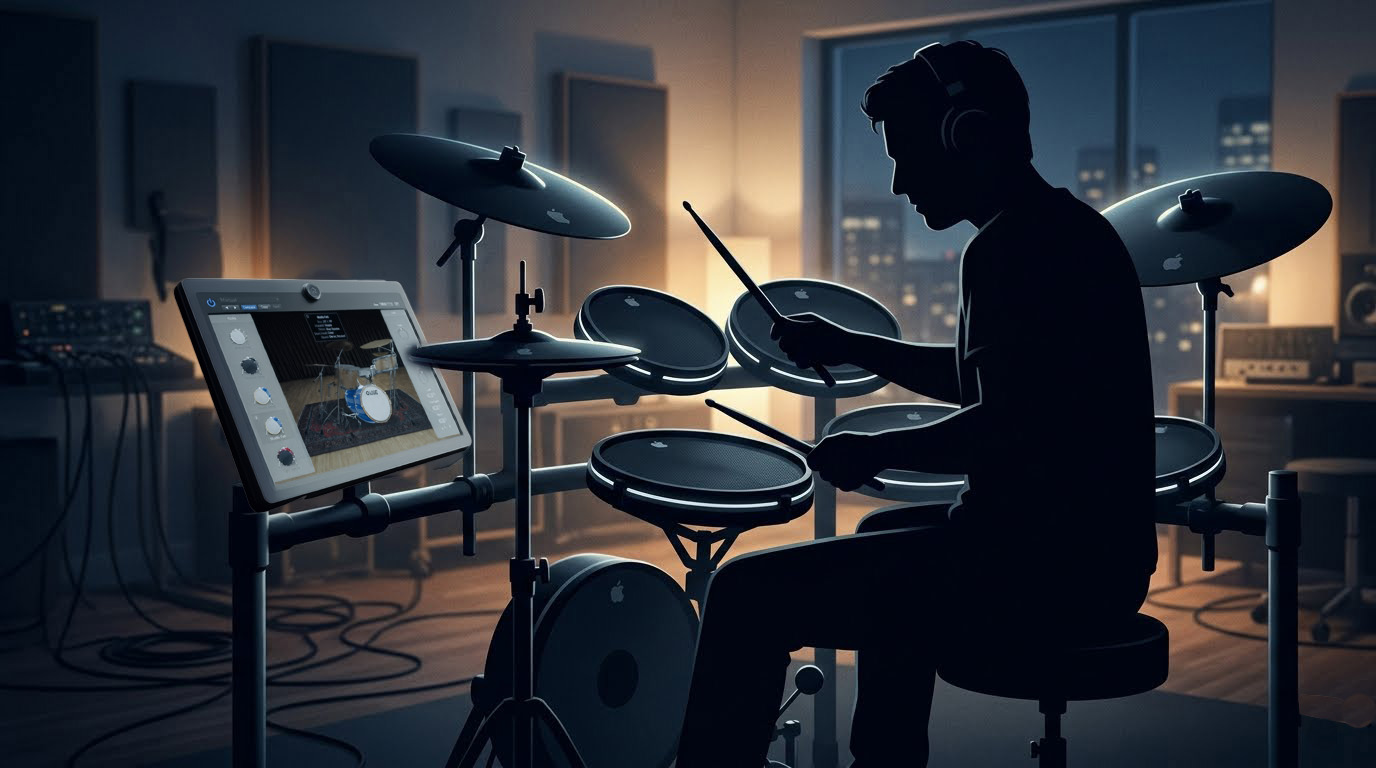
It’s a thought experiment that started as a throwaway idea, but the more I explored it, the more compelling it became. What if a team of ex-Apple engineers and designers — veterans of the iPhone, the Apple Watch, the M-series chip — turned their attention to electronic drums? What would they build?
The exercise is more than idle fantasy. Apple has elegantly solved many of the problems that have plagued electronic drumming for decades: latency, interface complexity, ecosystem fragmentation, haptic feedback and AI-assisted learning. The technology exists — it just hasn’t been pointed at a drum kit yet. So, let’s point it.
Start with the unboxing
Apple understands, better than almost any technology company, that the experience begins before you play a single note. The box, the reveal, the guided set-up — all of it counts. An Apple-designed e-drum kit would set itself up. Pads auto-detected. Module pre-configured. A guided wizard on the touchscreen that has you playing within 10 minutes of opening the box. No manual, no driver installation, no forum posts about why your hi-hat isn’t talking to your module.
And it would look extraordinary sitting in your living room. Think brushed aluminium and matte finishes, not black plastic and rack-mount steel. Jony Ive’s team once made a desktop computer so beautiful that people displayed it like sculpture. There is no reason a drum kit couldn’t command the same treatment.
Kill the piezo
Here’s the most radical idea: and it starts with haptics.
Apple has spent years perfecting the Taptic Engine: technology that translates electrical signals into precise physical sensations. The Apple Watch taps your wrist to notify you. The MacBook trackpad simulates a physical click that doesn’t actually move. Force Touch maps pressure gradients across a surface with extraordinary nuance. The Apple Pencil already translates the pressure, angle and tilt of a human hand into pixel-precise, nuanced input — apply the same logic to a drumstick and you capture not just velocity but character: the difference between a rimshot, a cross-stick and a glancing blow.
Now run that technology backwards. Instead of converting signals into touch sensations, convert touch — a drumstick striking a pad surface — into signals. No piezo transducers. No mesh heads. A haptic actuator array embedded in the pad surface that both receives and transmits. Hit the pad, signal goes out. But the pad also pushes back, simulating stick rebound, rimshot feel, even the difference between a coated batter head and a clear one. This is bidirectional haptics, and the building blocks already exist in your pocket.
Take it further: apply Apple’s pressure-mapping technology across the entire pad surface, not just the centre-weighted sweet spot that most triggers favour. Genuinely nuanced positional sensing and response, wherever the stick lands.
An interface worth looking at
The current state of drum module interfaces is, to be polite, uninspiring. Small screens, membrane buttons, nested menus that require the manual you lost in 2019. An Apple-designed module would be built around a large ProMotion touchscreen — 120Hz, always-on, showing your kit layout, mix levels and session data in real time. Drag and drop to reroute outputs. Pinch to zoom into a waveform. Swipe between kits.
One physical encoder, Apple’s equivalent of the Digital Crown, handles parameter control contextually, depending on what’s on screen. The result is a clean, uncluttered surface that doesn’t sacrifice tactile control.
Sit down and the module recognises you instantly via Face ID or a Touch ID sensor. Your kit, your sounds, your sensitivity curves, loaded automatically. Your partner sits down, their profile loads. Sticks in hand? “Hey Siri, load my jazz kit.” “Set tempo to 110.” “Add reverb to the snare.” Hands-free control, the way it always should have been.
The ecosystem play
This is where an Apple-designed kit would leave every competitor standing.
Today’s e-drum ecosystem is a patchwork of proprietary connections, third-party interfaces and compatibility compromises. Roland talks to Roland. Alesis talks to Alesis. Getting any of it to communicate reliably with your DAW is a minor engineering project.
Apple’s ecosystem just works — and for drummers, the implications are significant. Logic Pro integration wouldn’t mean compatibility; it would mean native unity. The module is a Logic controller. Record directly to a session on your Mac without an audio interface, latency managed at the driver level by Apple Silicon the way GarageBand already handles audio on iPad. GarageBand and MainStage would be equally at home, offering a continuous path from beginner to professional without switching platforms.
Your Apple Watch acts as another input, tracking BPM, logging practice sessions, analysing stroke consistency. Your iPhone becomes a second screen, a session camera, or a microphone for acoustic blending. AirDrop your MIDI file and session data to your Mac the moment you stop playing. And SharePlay, Apple’s FaceTime collaboration layer, could enable teacher and student to jam together in real time, with MIDI sync and the student’s hits visible to the teacher on a shared kit diagram. Remote drum education, solved.
Intelligence and awareness
Apple Silicon’s Neural Engine handles machine learning tasks on-device, privately and quickly. Applied to drumming, the implications range from the immediately practical to the genuinely exciting.
Ghost note recognition: the system learns your playing and distinguishes intentional ghost notes from accidental triggers, self-calibrating over time. Practice intelligence tracks your sessions across weeks and months, identifying that you rush on the left foot or that your snare velocity drops under pressure, and suggests specific exercises in response. Style recognition reads your groove and suggests appropriate kit sounds and room ambience to match. Every session is automatically transcribed to notation, exportable as a PDF or piped into an Apple Music score view.
Meanwhile, Ultra Wideband — the chip technology behind AirTag precision location — maps your physical kit layout automatically. Place a pad anywhere; the system identifies its position and configures accordingly. No zone assignments, no manual input. One Thunderbolt cable to your Mac, with a zero-latency audio interface built in. The kit knows where it is, who is playing it, and what they’re trying to do.
But the most radical reimagining wouldn’t be on the surface at all. It would be inside the box.

Rethinking the engine room
Almost every drum module ever made is built around the same two-part architecture: a trigger engine that converts pad impulses into MIDI, and a sound engine that converts that MIDI into audio. These are distinct hardware components, each with their own processors, firmware and upgrade cycles. Roland’s latest digital pads push some of that work — positional sensing and preliminary signal analysis — into the pad itself, distributing the processing across the kit. It’s clever, but it’s still fundamentally the same paradigm, just spread more thinly.
Apple would almost certainly scrap all of it.
The company’s history is one of collapsing hardware complexity into software running on general-purpose silicon. The iPhone eliminated the dedicated camera processor, the GPS chip, the accelerometer controller — not by removing the functions, but by absorbing them into a single, enormously powerful system-on-chip and handling everything in software. Apple Silicon’s M-series does the same for the Mac: tasks that once required dedicated audio interface hardware and separate DSP chips now run on one piece of silicon, faster and with lower latency than the hardware they replaced.
Applied to an e-drum module, the implication is radical: no dedicated trigger engine, no separate sound engine, no firmware to update, no hardware bottleneck constraining your sample library or polyphony count. Instead, a single M-series chip running a unified software stack that handles the entire signal chain — from pad impulse to audio output — in one continuous process.
The update argument may be the most powerful of all. A software-defined drum engine could evolve the way iOS evolves: continuously, over the air, with new capabilities that weren’t imagined when the hardware was designed. New trigger algorithms, new sample engines, new AI models — all delivered as updates to a module you already own. And for the adventurous, an open API could let developers and players build and share their own trigger curves, sample engines or entirely new playing modes. A drum module as platform, not appliance.
Cut the cable
If Apple were rebuilding e-drums from first principles, it’s hard to imagine them tolerating a kit held together by a spider’s web of cables.
Wireless triggering already exists: Drum Workshop’s DWe system has largely solved the cable problem, with latency that DW describes as virtually non-existent. The residual skepticism is less about the technology itself than about trust: interference from Wi-Fi routers, Bluetooth devices and other wireless equipment sharing the same crowded spectrum.
That’s precisely where Apple’s answer would differ — and the building blocks are already in place. AirDrop maintains fast, stable peer-to-peer connections between devices without touching a router. AirTags use Ultra Wideband to pinpoint location with centimetre-level accuracy in environments full of competing wireless signals. AirPods switch seamlessly between devices in real time, on a dedicated channel that ignores everything else around it. Apple has, in other words, already solved device-to-device transmission that is fast, precise and interference-resistant — across a range of real-world conditions that would challenge any wireless system.
Applying that to drum triggering, we could expect a dedicated short-range channel — operating on its own frequency band, encrypted to the specific kit’s hardware identifiers, invisible and inaccessible to any other device in the room. The pad itself would carry a small Apple-designed chip handling local signal processing, wireless transmission and power management, harvesting energy from the playing itself, the drum world’s answer to regenerative braking.
The engineering challenge of wireless e-drum triggering is not range, not bandwidth, and arguably not even latency. It is trust — convincing drummers that the invisible connection is as reliable as the cable they can see and touch. On the evidence of what Apple already ships, that trust would be well placed.
The design brief nobody has written
Apple, at its best, has always asked what should this feel like before asking what should this do. Current e-drum design is almost entirely engineering-led: trigger accuracy, module processing power, sound libraries. These are solved by engineers, for engineers, and the interfaces reflect that.
An Apple-influenced kit would start from the player’s physical and emotional experience and work backwards. That is a fundamentally different design brief. It’s why the iPhone made every previous smartphone look like a prototype. And it’s probably why no drum company — despite decades of iteration — has built a kit that a non-drummer would find beautiful, intuitive or desirable.
None of this requires technology that doesn’t exist. It’s all already there — the haptics, the Neural Engine, the Ultra Wideband chip, the ecosystem integration — sitting in devices that millions of people carry every day. It just needs someone to point it at a drum kit.
But let’s be realistic: Apple won’t be doing that anytime soon. Cupertino designs for markets in the hundreds of millions. Drummers are a rounding error on a global scale; e-drummers are a few decimal points further down. Unless there’s someone in the executive suite with a serious soft spot for electronic percussion — and stranger things have happened, this particular product pitch is never making it past the first slide.
So here’s a different call to action. The alumni network of one of the world’s most innovative companies numbers in the tens of thousands. Designers, engineers, machine learning specialists, product thinkers — people who have shipped world-changing technology and are now, perhaps, wondering what to do in their next act. Some of them play drums. Some of them have probably cursed at a drum module menu at midnight, wondering why nothing in this industry reflects the standards they spent their careers upholding.
To those people: the brief is right here, the technology is already in your hands, and there’s a global community of e-drummers who have been waiting — without quite knowing it — for someone like you to show up.