
Compared to mainstream “corporate” drum VSTs, there is a refreshing candour about Deviant Drums that hits you before you have even loaded the first kit. The manual is written entirely in the first person by a developer who openly admits he kept recording until Kontakt ran out of room, describes four of the keyswitch effects as “destructive, angry, edgy, and mean,” and named another simply “Punish.” This is unequivocally not a mainstream drum library.
Yet behind the eccentric personality lies a genuinely serious piece of software — one that rewards close attention and repays the time invested in understanding its architecture.
What’s in the box
Deviant Drums is a Kontakt-format instrument from Chaos Tones that runs on the free Kontakt Player, so users do not need a full Kontakt licence (currently around $200).
The sampling depth is substantial: nine acoustic drum kits, 17 named snare drums across multiple tunings yielding 48 distinct snare sounds, and a selection of TRX cymbals, captured with up to eight velocity layers and seven round-robins per instrument across nearly 20,000 sample files. Despite this, the installed footprint is a lean 13GB. An onboard memory manager can reduce RAM usage from roughly 2.3GB down to approximately 365MB for the same kit — a near sevenfold saving that will be appreciated on modest systems.
The kit list reads like a serious session drummer’s backline wish list: Yamaha Oak Custom, Pearl Session Custom, Pearl Masters Birch, a 1996 DW Pre-Collectors Birch Prototype, two Tama Starclassics, a Yamaha Maple Custom, a Mapex Pro M, and a Ghost Drums kit of uncertain vintage. Snares span everything from a Canopus 14×6.5″ and a Gretsch Vintage Round Badge to signature models from Virgil Donati, Chris Adler, and Joey Jordison — the Donati alone contributing three distinct tunings.
Recording was meticulous: ceiling-mounted overhead and room mics time-aligned for phase coherence, an Audix D6 on every kick, Sennheiser MD421s and Audix D2s and D4s on toms, Beyerdynamic M201 or Shure SM57 on most snares, with premium API and SSL outboard EQ applied during tracking. Three mic perspectives — close, overhead, and room — are available per instrument and independently controllable throughout.
The interface
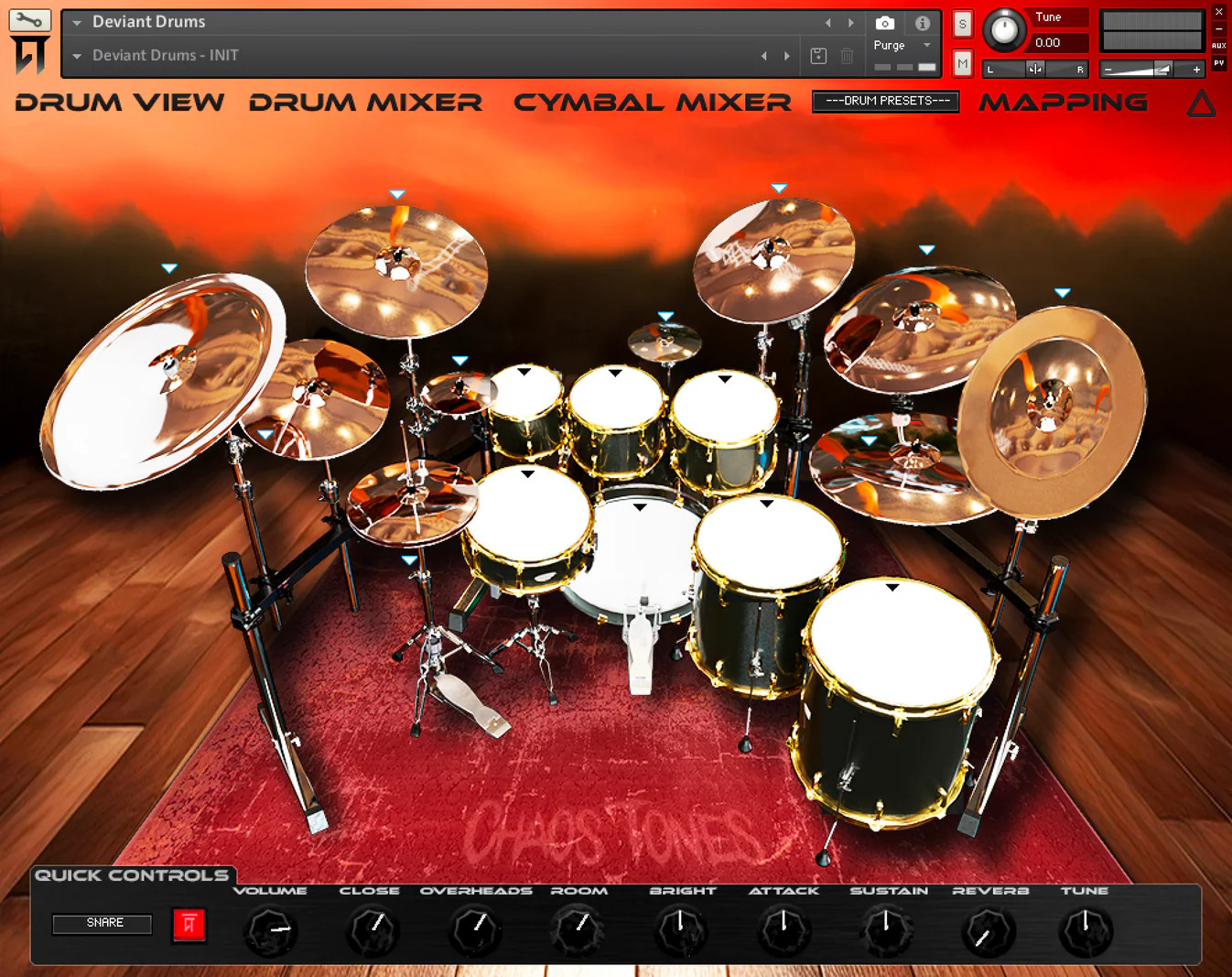
The primary Drum Edit window presents a visual kit layout; clicking a pad graphic previews the sound while a dropdown swaps instruments. A Quick Controls strip below gives immediate access to mic levels, brightness, attack, sustain, reverb, tuning, and a Tom Link toggle. It is not a pretty layout, but a sensible first layer that keeps common tasks within reach.
The main Drum Mixer expands the scope considerably. Each channel carries independent tuning, pan, fader, solo/mute and a default reset. The Smash button — a parallel compression and saturation circuit active by default — creates an aggressive soundscape that I had to disable for general use, though metal players will be grateful for the additional weight. A hidden panel behind each channel’s tape label reveals a four-band EQ, transient shaper, reverb send and frequency shifter, with an LED indicator confirming whenever anything inside has been altered.
The Cymbal Mixer mirrors the drum layout with two exceptions: its Smash button applies shimmer rather than compression, and cymbal processing is global rather than per-instrument — a limitation the developer openly acknowledges.
Two VCA channels allow broad relational adjustments across all linked channels simultaneously. Want less room ambience across the entire kit? One fader move. It is an elegant solution to multi-channel VST mixing that speeds up workflow considerably.
In action
Deviant Drums was clearly designed primarily with non-drummers and programmers in mind — product walkthroughs and demo videos exclusively show MIDI keyboard triggering. The e-drum mapping selection reflects this: presets for Roland, Alesis Strike, and Yamaha DTX only, versus a heavily populated list of software drum sampler maps for BFD, Superior Drummer 3, EZdrummer 3, Addictive Drums, and Logic.
For testing, I set my module’s MIDI output to a standard Roland TD-20 profile and selected the corresponding map. It was accurate enough out of the box, but I struggled to get the hi-hat fully dialled in — particularly closed-hat articulations. Even with the pedal pressed flat, the engine still triggers a hint of sizzle. In a wall-of-sound metal mix this is not a dealbreaker, but it becomes an annoyance when chasing nuanced ghost notes and dynamic finesse.
I should offer two confessions: I am not a traditional metal fan, and I have historically preferred dedicated standalone drum instruments over complex Kontakt libraries. Those biases noted, the drum arsenal here is immense. The acoustic kits are fundamentally tracked for heavy, hard-hitting performance, and the vast snare selection similarly skews toward the aggressive and weighty. The library includes dozens of production snapshots featuring massive room reverbs and artificial low-end sub-enhancement. Safe to say, you will not be reaching for this if you are tracking an ABBA tribute band.
The cymbals offer a dramatic contrast — clean, bright and highly articulate, including a Zildjian A ride, a K Light ride, Paiste 14″ Signature hi-hats, a Wuhan 12″ splash, and a Meinl Byzance crash. In their un-effected state they sound crisp and airy, and their top-end can be pushed further with the Cymbal Smash.
Deviant is not equipped with positional sensing, which is understandable given it was not designed for e-drummers with larger playing surfaces. More notable omissions for electronic players are the complete lack of rim samples on the toms and no dedicated rimshot samples on the snares — standard centre-head hits and sidestick articulations only. The ride successfully supports bow, bell, and edge triggering, though I could not locate a parameter to manually adjust the assigned edge MIDI note.
The hybrid integration, however, works seamlessly. Nineteen EDM kick and snare combinations sit on a dedicated mixer channel with independent level, extended tuning (up to four semitones) and an isolated Smash button. The EDM Unison button links acoustic and electronic elements to a single MIDI note without flamming, and the developer notes the engine is tolerant of humanised timing. E-drummers familiar with layering electronic transients in a drum module will find this immediately intuitive. Latency was not an issue — at a buffer size of 128, response felt comparable to Superior Drummer and Addictive Drums.
Presets and speed
Over 70 snapshots cover classic rock, modern metal and more experimental processed territory. A quick menu accessible from any page allows kit, cymbal or master configuration changes without leaving the active edit screen — a genuine workflow advantage for studio producers on tight deadlines. Even for a non-metal player, the core sounds cover a broader stylistic range than the marketing suggests and can be massaged effectively through the presets or manual editing.
Bottom line
Deviant Drums stands apart from the sea of clean, safe VST options on the market. It delivers an uncompromising selection of heavy, muscular kit sounds ideally suited to metal, punk and hard rock production. The interface skips visual glamour in favour of raw practicality, and the deep micro-editing capabilities — transient shaping, individual mic phase adjustments, per-drum processing chains — go well beyond what most e-drummers will ever need. For mix engineers who demand precise control, the toolset is impressively robust.
There are a few software quirks and implementation gaps that e-drummers will notice, and the hi-hat choke limitation in particular is worth flagging to the developer. But the fundamentals are strong, and the single-purchase model with no expansion packs and a functional free trial makes the entry proposition unusually straightforward.
At $129.99 (currently on sale from $149.99), Deviant Drums sits comfortably at the budget-friendly end of the high-fidelity drum VST market. If you produce heavy music and want depth, character and genuine sonic weight without a subscription or an expanding pack library, it deserves a serious look — starting with the free version, which you have absolutely no reason not to try.
Specifications
Platform: Kontakt Player (free) compatible
Content: 9 acoustic kits · 17 snare drums · 48 snare sounds · 19 EDM kick/snare combinations · TRX cymbals · ~20,000 samples · 13GB installed
Sampling depth: Up to 8 velocity layers · Up to 7 round robins · 3 mic positions per drum (close, overhead, room)
Mixing: Per-drum and per-cymbal Smash button · Per-drum hidden panel: 4-band EQ, transient shaper, reverb, frequency shifter · Cymbal tape saturation · VCA group channels · Tom Link · Master compressor, 4-band EQ and saturation · Decay controls per drum and cymbal
Routing: Up to 16 DAW output channels · Dedicated overhead and room outputs (ch. 17–18) · Master internal mix option
MIDI: Polyphonic/monophonic switchable mapping · MIDI learn per instrument · Custom map save/load · Per-drum velocity min/max with batch faders · EDM Unison (flam-free acoustic/electronic layering)
Keyswitch effects: Space · Anger · Break · Punish · Brutality Knob · Per-keyswitch trim faders
Presets: 70+ snapshots · Separate kit and mix presets · Quick menu (accessible from any page)
Other: Memory manager (~7x RAM reduction) · Random kit selector · Single purchase, no expansions
Street price: $129.99