We’ve had a few reader enquiries about Unlock e-cymbals, especially in the wake of our exhaustive reviews of rival Lemon cymbals. After various attempts at sourcing review samples, we finally got hold of a new 20″ three-zone ride (CY20R, with no logo or branding on the top) and a Lightning Series 14″ hi-hat.
By way of background, Unlock is a relative newcomer to the e-drum market. Having launched in 2018, Unlock produces and sells e-drums under its own brand as well as providing OEM services for overseas brands. The company has partnered with around 20 organisations, but it’s hard to gauge its success in comparison with rivals like Medeli and Ringway because it will supply as few as five units for any partner.
On the retail front, the company sells direct via platforms like Alibaba and through e-drum retailers around the world, including drum-tec and Vybe Drums in Europe and Edrumcenter and Dolby Drums in the United States.
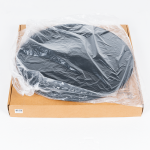
Our review samples were supplied direct from the factory in China and arrived securely boxed, but with no documentation or set-up instructions.
What’s in the box
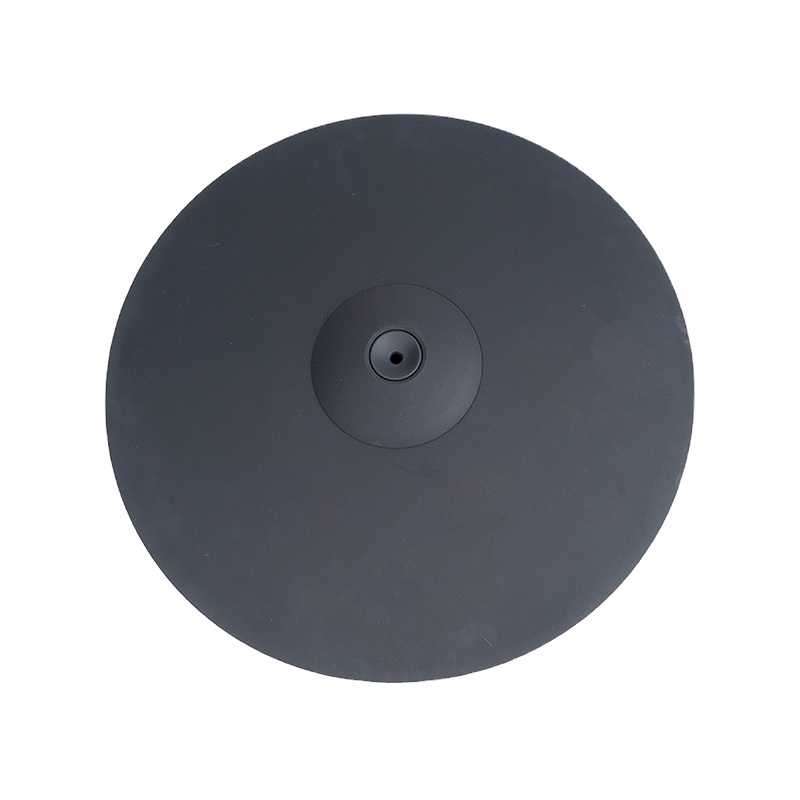
The ride is a full 20″ silicone-covered cymbal boasting 360-degree triggering around the edge, bow and bell. The dark charcoal playing surface has a pleasant, high-quality feel – almost Efnote-ish in texture – and the cymbal is realistically shaped, with a generous raised bell area.
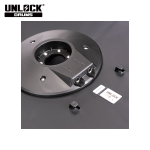
On the underside, there are two inputs, labelled Ride and Ride Bell (more about that later).
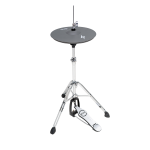
The hi-hat is a two-piece set. The top hat is a grey 14″ three-zone cymbal emblazoned with a large Lightning Series logo that looks much larger than it needs to be. The bottom ‘cymbal’ is more like a plate with a controller mounted in the centre.
Setting up
The physical set-up of the ride was straightforward, but the hi-hat was not without its challenges. The ride was supplied with a Roland-style anti-rotation mount which slipped onto a regular cymbal stand.
The hi-hat, however, was more challenging because the clutch has a very narrow opening – far too small for any of the pull rods on the hi-hat stands in my vast collection. Luckily, I had the tools to rebore the opening, but I honestly can’t see too many buyers being able or willing to drill into their clutch to make it fit. Once this was done, it was smooth sailing.
In action
While the company doesn’t seem to provide specific compatibility information, there seems to be a general consensus that Unlock cymbals work well with current Roland modules and a few others.
Readers who saw our Lemon reviews will recall that this kind of aftermarket e-cymbal generally comes in two ‘configurations’ – ride or crash – with two versions of the internal connections. Unfortunately, the factories are not always consistent with their wiring, so you can never be totally sure which set-up you’re working with – short of opening the cymbal and checking.
I’ll start with the ride, because that’s more complicated. My sample was configured as a Roland-style ride – suited to modules requiring separate Ride and Ride Bell inputs.
On a Roland V51 module, I started with the CY-16R-T preset and got excellent bow and edge triggering. The playing area is clearly much larger than the expanse for which the preset is designed, and I had to raise the threshold for the edge to dial some of its response out of the bow triggering. Unfortunately, there is no separate bell adjustment on the module, so the universal threshold bump had a slight impact on overall responsiveness. That said, the cymbal produced decent triggering, positional sensing, good edge washes and a distinct bell ping without too much effort.
I have to admit that it was downhill from here.
Connected to a Roland TD-30, which requires a Ride (bow and bell) and a Ride Edge, the Unlock initially produced ‘reversed’ triggering – the edge triggering on the bell zone and vice versa. Even switching the internal wiring didn’t fix that issue, producing just a single-zone response.
The ride was also problematic with the 2box drumIt3, despite that module appearing on drum-tec’s official compatibility list for the range. No matter which way it was wired, I could get, at best, edge and bell triggering, or just bow on its own – but not reliable three-zone response. It’s possible this was a wiring-configuration issue specific to my sample.
Similarly, I couldn’t get acceptable multi-zone triggering on the Alesis Strike, the GEWA G9 or the Yamaha DTX Pro. The DTX Pro issue has a plausible technical explanation: forum users have reported that the Unlock’s output impedance appears to exceed the threshold Yamaha modules use to distinguish a bell hit, causing the edge trigger to be misread as the bell – and vice versa. It’s a fundamental signal incompatibility, not easily resolved through settings adjustments alone.
I have, however, been reliably informed that all three zones work as they should on the mimicPRO and Efnote modules. Indeed, Dirk Brand will be using Unlock cymbals with a mimic at the digitalDrummer E-drum Labs at the Europe Drum Show in April.
Once the hardware limitation was overcome on the hi-hat, the performance experience was significantly better than the ride.
Performance on the V51 was excellent. Using the VH-13 setting, I only had to adjust the offset manually to get an extra-tight response. Overall, I got good triggering, bow and edge separation and excellent open/closed transitions. Foot splash sensitivity only needed a slight boost.
The cymbal performance on the GEWA G9 was good, but the controller was incompatible and would not produce open articulations – despite the G9 appearing on drum-tec’s compatibility list for the Unlock hi-hat. It’s possible this reflects a difference between the cymbal pad and the controller, which may use a different signal format.
The controller didn’t work on the Yamaha DTX Pro or the Medeli MZ928 either, so caution is advised if you’re planning to use the rig with non-Roland brains.
Overall
The Unlock products look and feel like a step up from the Lemon offerings, but I was shocked at the lack of real-world compatibility. The Lemons worked with a far wider range of modules.
When paired with a compatible brain, the Unlocks were impressive. The ride, in particular, showed true full-surface sensitivity, easy bell triggering and an effective edge-pinch muting action.
The hi-hat was excellent when connected to a Roland V51 – certainly on par with Roland’s analogue hats.
The cymbals feel good – both under sticks and when you run your hands over them – and the construction seems robust. I have yet to see many quality control issues discussed on social media, and I’ve had no reader complaints.
The biggest issue, of course, is compatibility – especially for the three-zone ride and the hi-hat controller – and I’d urge caution, especially with older and non-Roland modules. The discrepancy between drum-tec’s published compatibility lists and my real-world experience suggests that results may vary depending on the wiring configuration of individual units.
In terms of value, the cymbals are reasonably priced, with the hi-hat costing $180 and the ride coming in at around $220 direct from the manufacturer – shipping extra. They are slightly more expensive from resellers, but that’s worth it for people who have an understandable aversion to navigating Alibaba.