
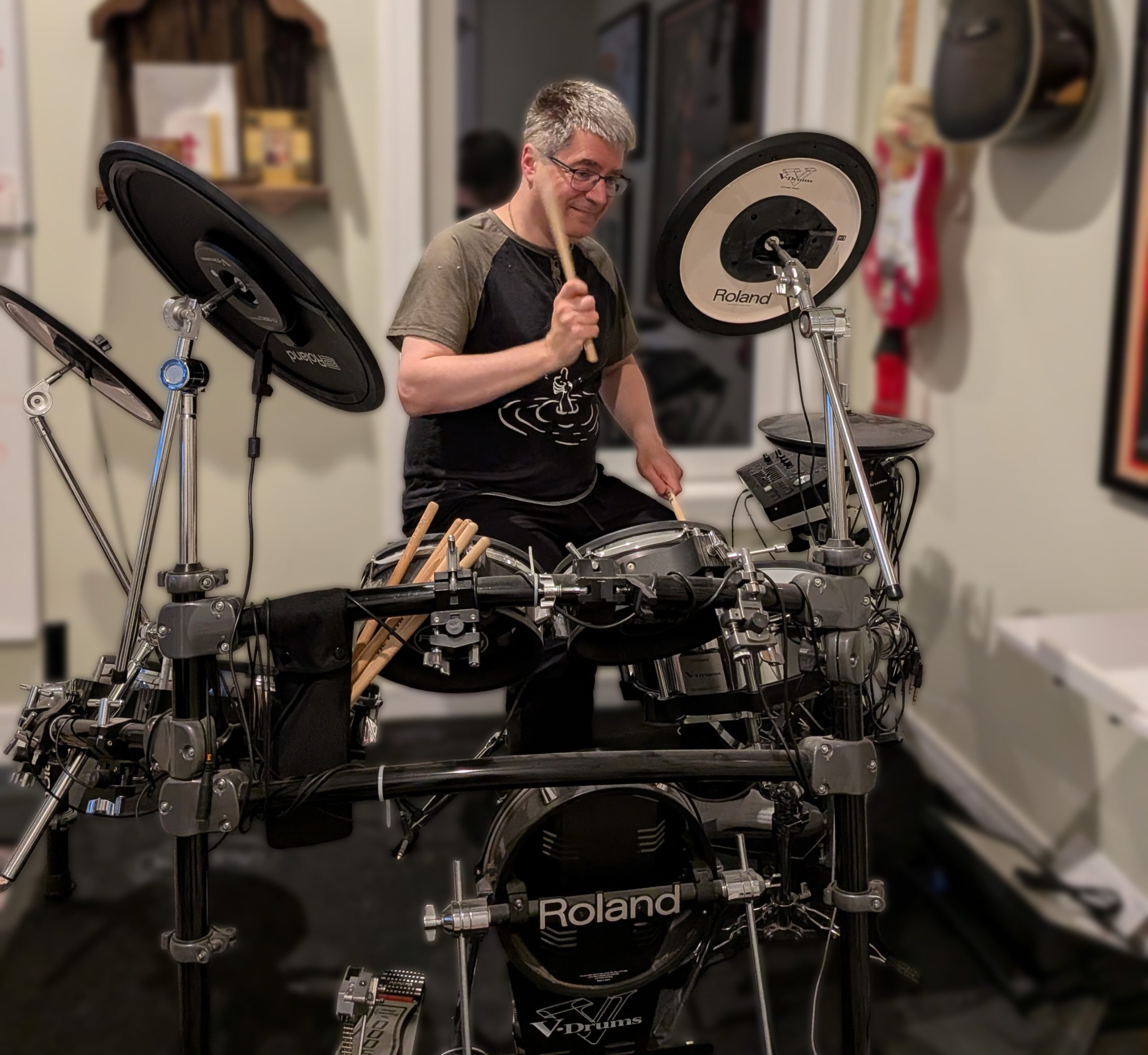
With a new album under his belt, Refestramus drummer and songwriter Derek Ferguson finds his e-kit invaluable for practice and composition.
My family had a rule about new pursuits: do things properly, or don’t do them at all. So, when I wanted to play drums at age nine, the deal was a year of lessons first, to prove I’d stick with it. I did, and got my first drum set.
My path since then hasn’t been the usual one. For most of my adult life I’ve been a programmer, including a stretch at Bear Stearns on Wall Street — a “Wolf of Wall Street”-intensity environment I survived without ever doing anything of which I’m ashamed. That job matters to this story, because my first bonus there, in 2005, went straight into a Roland TD-20. The kit was my trophy for making it through — a purple heart in drumsticks.
Twenty-one years later, that kit is still with me. During the pandemic, I upgraded it with the TD-50 digital pack — the new brain, the PD-140DS snare, and the CY-18DR ride — specifically so I could record audio directly from the module. Everything else, right down to the original TD-20 rack, is the 2005 kit. I consider the V-Drums line’s longevity and upgradeability a feat of engineering few pieces of technology can match. How many things bought in 2005 are still at the centre of anyone’s creative life?
These days the centre of mine is Refestramus, the Chicago-based prog rock project I founded and write for. The name is a word my mother made up meaning “rearrange” — we liked that it wasn’t a real word, because a web search turns up only us. Our third album, Morri’s Rock Boutique (Melodic Revolution Records), features eight of my songs plus a prog adaptation of a traditional Russian folk song, The Cossack’s Dream. In November 2025, we played the HRH 15 Prog Festival with Van der Graaf Generator saxophonist David Jackson as our special guest.
Being the songwriter behind the kit changes how I hear drums — I think melodically rather than in terms of power and punch — and the TD-50 is central to how the songs get made. The drums on our first two albums are entirely TD-50. Even Morri’s Rock Boutique, tracked acoustically in a studio, was demoed completely on the kit: I record audio straight out of the TD-50 and send it to our producer, Ian Beabout. No mics, no room treatment, no studio clock running: I can capture an idea the moment it exists and hand over tracks that sit in a mix.
The other thing e-drums give me is the ability to play at all. I live in a condo in Lake View, Chicago, and I have no desire to be the neighbour from hell. The TD-50 was already quiet enough by virtue of being electronic, even on a wood floor — but when our downstairs neighbours recently had a baby, I went further: full room carpet, 3” foam absorber blocks, and an Auralex acoustics rug on top. Now the folks immediately below us can’t hear us at all. For a writing drummer, that’s not a convenience — ideas don’t keep business hours.
I still love acoustic drums; my TAMA Starclassic Maple/Birch and Zildjian K Custom Darks are voiced to sing rather than just hit. But the TD-50 is where the songs are born. A drum kit isn’t just a rhythm machine — it’s another instrument in the song, and the electronic one is the instrument that’s always ready when the song arrives.
Gear list
Electronic kit:
Roland TD-50 module, PD-140DS digital snare, and CY-18DR digital ride (TD-50 digital upgrade pack); 2x PD-105 tom pads; KD-120 kick; VH-13-MG hi-hat on Yamaha hi-hat stand; 2x CY-14C crashes; original TD-20 rack; DW 9000 kick pedal.
Acoustic kit:
Tama Starclassic Maple/Birch Lacquer shell pack; 14×6.5″ Tama Starclassic Performer Maple Walnut Carmel Aurora snare; Zildjian K Custom Dark 4-piece cymbal pack.