
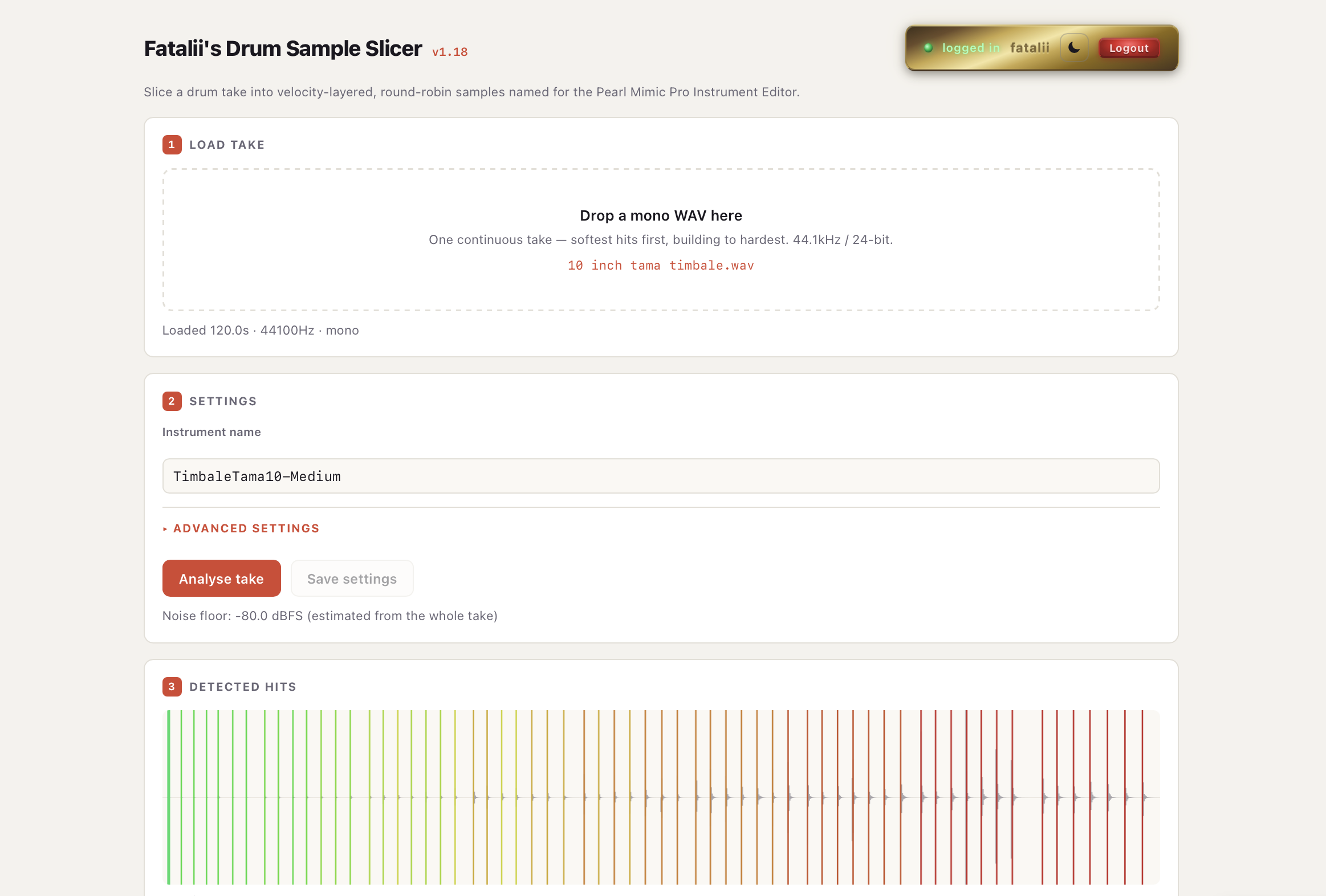
A Finnish drummer and chilli pepper grower has built a free, browser-based sample slicer that could change the way e-drummers approach custom sampling.
Jukka “Fatalii” Kilpinen, best known in hot pepper circles for his eponymous seed company, has spent four decades behind a kit and the last 20-odd years on electronic drums. His current set-up centres on a Pearl mimicPRO brain driving a converted Pearl acoustic kit with mesh heads and Drone triggers. When he moved to the mimic, he wanted to fill gaps in its library with his own samples — mini-timbales, octobans, rototoms — and quickly hit the wall that stops most drummers from going further.
“Anyone who has done deep multi-velocity, multi-round-robin sampling knows the editing is painful,” he says. “Chopping one long recording into dozens of perfectly trimmed, correctly named samples by hand is mind-numbing work.”
So, he built a tool to do it for him.
How it works
Fatalii’s Drum Sample Slicer runs entirely in the browser — no download, no install, Mac or PC. The workflow is straightforward: record all your hits in a single WAV file, drop it into the app, and let technology handle the rest.
The app detects every hit automatically, coping with the long ringing tails of real drums and with the wide dynamic range you get when soft ghost notes sit in the same recording as full-force strokes. It then trims each sample, applies fades and names the files in sequence, sorting them into velocity layers and round robins ready for export.
A sample-picking step lets you discard any bad hits before export — one keystroke per reject, no surgical editing required. Kilpinen aims for roughly 50 to 100 samples per drum for toms, timbales and octobans, more for snares, sometimes fewer for kicks.
There’s also tuning control — global or per-hit — and an auto-tune option that addresses a real-world problem: pitch drift over a long session, or the slight drop that happens when you really lay into a rimshot. “The loudest hits can end up a little flat compared to the first hits,” Kilpinen explains. “The app detects this and corrects it automatically, with adjustable strength, so you can keep things sounding natural rather than robotically perfect.”
A keyboard playback mode lets you audition the finished samples before export — soft to loud across the number keys, with round robins and one-drum choke behaviour — so you can hear how the instrument will actually feel.
Output is standard 24-bit / 44.1kHz WAV, which means the files work with the mimic and any other brain or software sampler that accepts custom imports.

Built with AI assistance
Kilpinen is candid about his coding background — or lack of it. “I did a bit of programming as a teenager and never took it much further,” he says. What made the project possible was a combination of AI-assisted development and a platform called Aimeat.io, which lets non-developers publish browser-based apps without wrestling with the underlying infrastructure.
Free, with community ambitions
The app is free. There’s a “buy me a coffee” option on the site, and Kilpinen isn’t ruling out commercial features down the line, but he’s clear that income isn’t the driver. “My biggest motivation is to get people excited about sampling their own acoustic drums, and through that, to get more samples circulating in the community.”
His first finished instrument, a sampled 10″ Tama mini-timbale, is already available for download.
Sampling guides are in progress, and Kilpinen is actively looking for testers, feedback and fellow samplers with interesting drums.
You can find the app and samples at fatalii.net/drum, under the banner “Fatalii’s Hot eDrum Stuff” — a nod to the day job.
